
The violin is the smallest and highest-pitched member of the bowed string family. That family also includes the viola, cello, and double bass. It produces sound when a player draws a bow across its strings and sets them vibrating, though the strings can also be plucked. Valued for its expressive, singing tone, the violin holds a central role in classical music. It serves as both a solo and an ensemble instrument.
1. The Four Strings and Tuning #
The violin has four strings, tuned in perfect fifths to the pitches G, D, A, and E, from lowest to highest. Tuning in fifths means each string sits a consistent interval apart. In fact, most of the bowed string family shares this same pattern.
The player changes pitch by pressing a string against the fingerboard to shorten its vibrating length. However, the violin has no frets. As a result, the exact placement of each finger determines whether a note is in tune. This makes accurate intonation one of the instrument’s central challenges.
2. The Body and Its Parts #
The violin’s hollow wooden body acts as a resonating chamber that amplifies the strings’ vibrations. Ribs connect its curved top and back, while two f-shaped sound holes let the vibrating air inside project outward.
The neck extends from the body and carries the fingerboard, over which the strings run. At the top, the scroll houses the pegbox and tuning pegs. Meanwhile, at the base, the tailpiece anchors the strings. Finally, a small wooden bridge transmits the strings’ vibration into the body.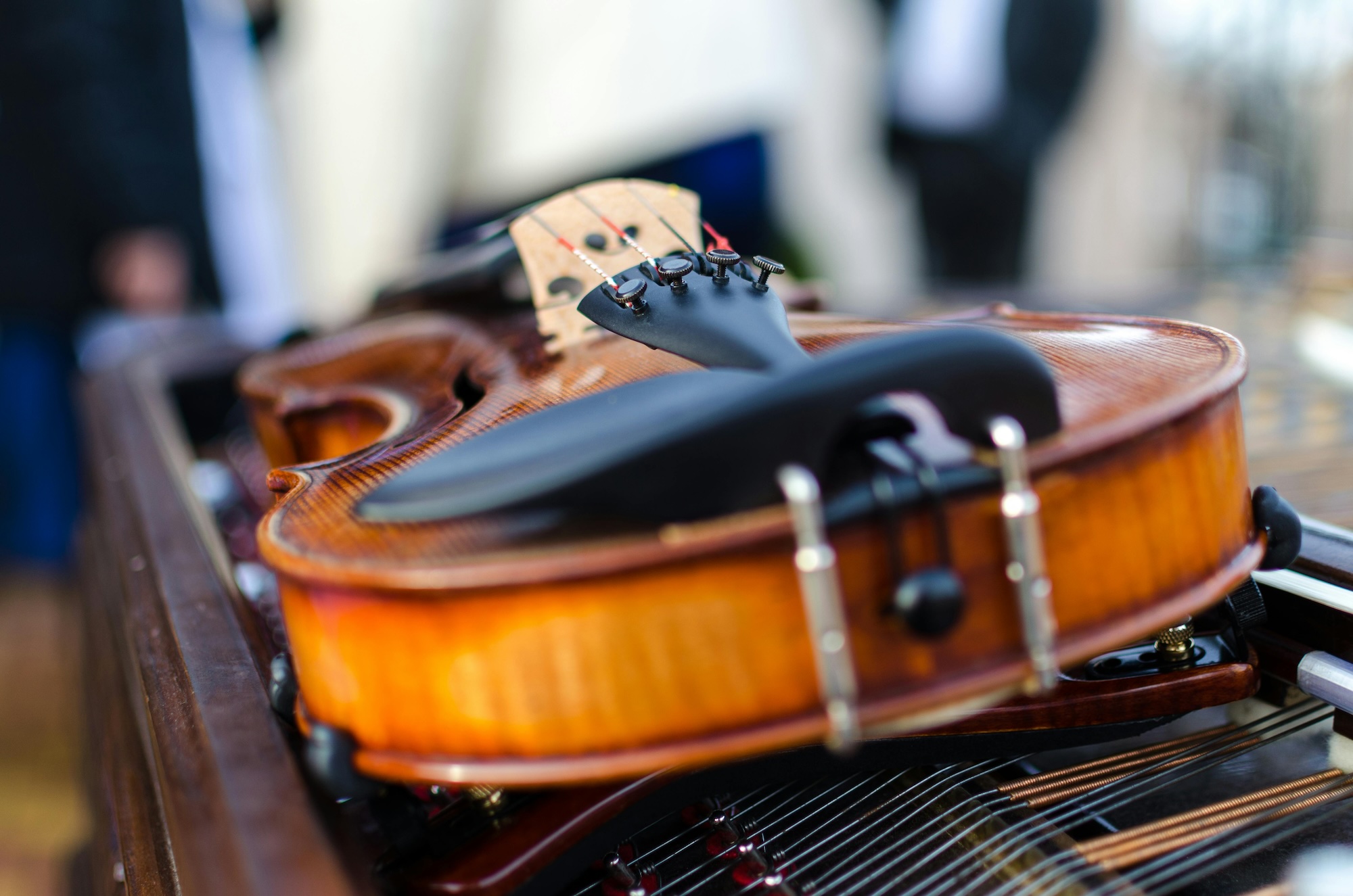
3. The Bow #
The bow is a separate implement. It consists of a slender stick, traditionally wood, strung with horsehair that a screw mechanism at the frog holds under tension. Drawing the hair across the strings sets them vibrating, and this is the primary means of producing sound.
For the hair to grip the strings, it needs rosin, a hardened tree resin that adds friction. Without rosin, the bow slides silently over the strings. Above all, the angle, speed, and pressure of the bow shape nearly every aspect of tone and articulation.
4. Sound Production and the Soundpost #
As the bow sets a string vibrating, the bridge transfers that motion to the top of the instrument. Inside the body, a small dowel called the soundpost stands between the top and back. This dowel couples their vibrations, and it plays a decisive role in the instrument’s tone and volume.
The precise position of the soundpost strongly affects sound quality. For this reason, skilled hands fit and adjust it rather than gluing it in a fixed location. Even small changes in its placement can noticeably alter how the instrument responds.
5. Fractional Sizes for Younger Players #
Violins come in a range of fractional sizes, such as 1/16, 1/4, 1/2, 3/4, and full size, described as 4/4. These smaller instruments suit the shorter arms and smaller hands of children.
A player’s arm length, rather than age alone, determines the right size. As a young player grows, they move through larger sizes until they reach a full-size instrument. Consequently, they can maintain comfortable and correct technique at every stage.
The Chopin Academy of Music Approach #
The Chopin Academy of Music provides violin lessons that combine Eastern European and American teaching traditions. This approach emphasizes correct technical foundations alongside artistic development. Moreover, we tailor every lesson to the individual, from the earliest beginner to students preparing for advanced solo and ensemble performance. To support that growth, students may also join our group classes in theory and ear training.
Our internationally credentialed faculty brings more than twenty years of experience across our Washington locations. A North Scottsdale, Arizona location is now joining as well. In every case, we approach string training within a structured, individualized program of study. To begin, schedule a complimentary consultation with our string faculty.


